Tuesday, November 08, 2005

Jimbocho, Ueno, and the Last Samurai

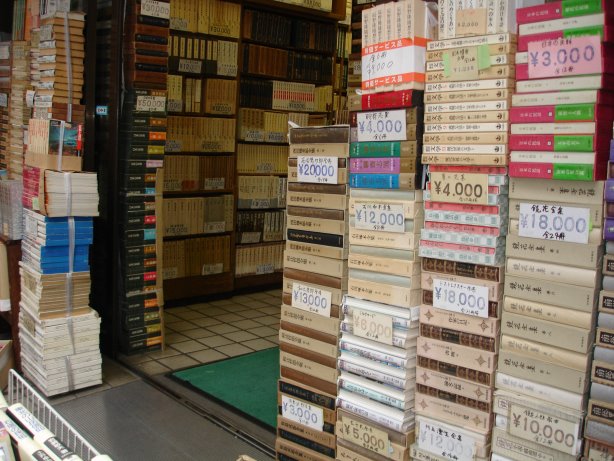
Just so you know, Jimbocho, the book district, has nothing to do with The Last Samurai, but I like the district, so I took a picture and thought I should include it.


On the far right are the complete works of Izumi Kyoka. For only 18,000 Yen!

The next couple of photos do have something to do with the movie.

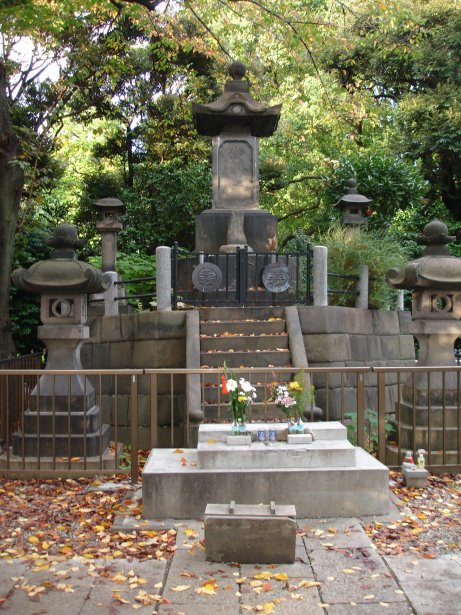
I went to Ueno Park, in northeastern Tokyo, yesterday. Ueno is a symbol of the amibivalence of Japan concerning its modernization and westernization. Under the new Meiji imperial administration in Tokyo, Ueno became the first public park in Japan and it is synonymous with the defeat, in 1868, of the final stand in Tokyo against the restoration of the Emperor to power. And yet, the statue in the picture above, located in Ueno, commemorates these loyalists to the Shogun.


Even more evocative of the lingering misgivings about the destruction of the samurai class and headlong pursuit of Western industry and military strategy is the nearby statue of Saigo Takamori, the figure upon which The Last Samurai is loosely based.

Takamori was, at first, a supporter of the Meiji Restoration, but with the threat of the destruction of the samurai class, Takamori turned against Meiji and was involved in the Satsuma rebellion, depicted in very exaggerated terms in The Last Samurai. He, like the Ken Watanabe character, knew he was overwhelmingly outgunned, but the rebellion, as we see in the movie, made its point. He committed suicide soon after the rebellion failed.

In this society that celebrates the ritual suicide of 47 samurai who avenged their lord and then killed themselves despite a reprieve, the samurai-class opposition to the new emperor romantically embodies the dignified past in Japan. For those tiring of the coorporate cultural here that separates men from their families and is slowly destroying the natural and cultural history of Japan, they represent an escape, an answer sometimes. Most of my male friends worship these figures of what is called the Bakumatsu period or the end of the shogunate. I don't think any of them particularly care for the shogunate; it is the character of these men who fought against the emperor newly restored to power that they are interested in. It is a dignity that the generation before them don't seem to have, working in cubicles for profits rather than on the field of battle for their lord and the title of "samurai" itself.

It is, of course, far more complicated than this. But I have been struck by this interest in the past. I suppose it is like cowboys, but my interest in cowboys didn't last past 10, whereas many of my friends are in their mid-twenties. Ah, well, I'll leave it at that. Maybe some day when I know more I'll return to it.

Just a couple of more pictures that I forgot to add the other day.
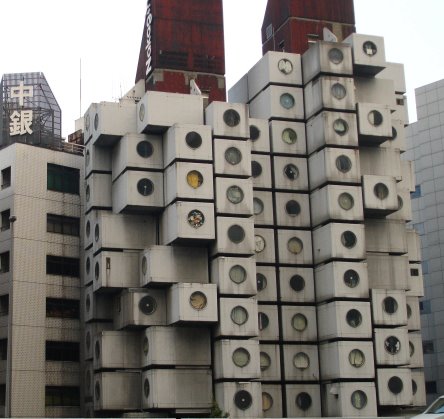
The first is the picture of what looks like an apartment complex. I'm guessing it is a capsule hotel, where you can sleep in an 8 by 5 by 5 capsule for very cheap. Very Blade Runner, I thought. Or Terry Gilliam's Brazil. You probably pay extra for the windows - other capsule hotels don't have such luxuries because they are often a place to stay for businessmen on work-related trips.


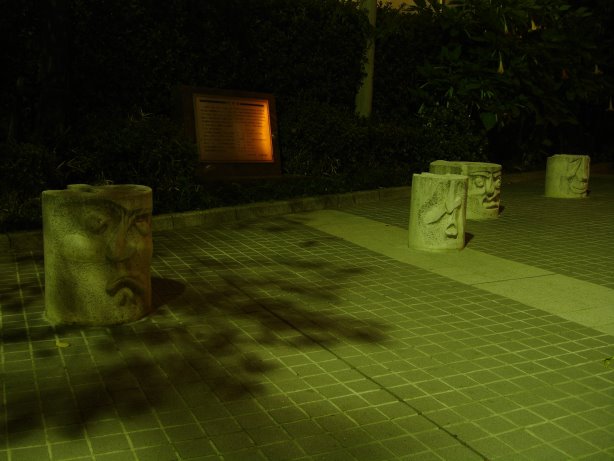
Last, faces on the sidewalk.

Monday, November 07, 2005

No news is good news

I thought I should tell everyone I haven't heard anything more about Misha. I hope he's being taken care of. I worry about him, but need to get on with my life.

Sunday, November 06, 2005

Neighbor problems

The police came for my neighbor today. He had been eating my food, washed the computers (not mine, luckily) with water, and even more than that had soaked floor in his own room in water and seaweed and used his garbage as a toilet.

The whole thing has been a travesty, and it isn't over yet. I guess the cops came for him earlier today. However, the stupid Swedish embassy (he's from Sweden) is actually closed today, which I think is absolutely ridiculous. So the police left him at Ueno station! Unbelievable. The guy has very obvious mental problems, no money and no food, and their solution is to leave him at a fucking train station. Sorry for the language, I haven't slept much and this whole thing has made me really angry.

In fact, I didn't sleep at all last night - both because the guy was running his water all night long and because I drank too much coffee. I finally gave up at 8 this morning and went to Meiji jingu in the hopes that would calm me down. It did, and I actually had a great day despite the fact I was so tired.

When I came home he was gone. The manager said he was going to call the cops today so I expected that. But I had a feeling it wasn't over. Exhausted, I went to sleep.

I woke up a couple of hours ago and heard his distinctive voice in the kitchen. I couldn't believe it, but there he was, back at the computer and back at making weird mixes of my food. Though I don't have any claims on this common room, I felt as though a robber had broken in and was messing with my stuff. I immediately went to see the manager, who was as shocked as I was to hear he was back.

We had the manager's Japanese roommate call the police and once again they came. The police said that since the embassy was closed there wasn't much they could do - understandably they didn't want to arrest a foreign national when no real crime had been committed. What makes me sick is that there is nothing else that can be done - psychiatric hospitals here appear to be reluctant to take foreign patients. But the cops took him again, told us to lock the door and call if he came back again - because, like before they were going to leave him at Ueno station! Absolutely absurd.

It is raining outside and cold, he doesn't have a place to stay and he doesn't have any money and isn't carrying a passport. I don't think he has eaten a real meal in days and, while he is fairly coherent, he is definitely having a psychotic episode. Who wouldn't be frightened and angry in such a case. On top of that, he doesn't speak Japanese.

I don't even want to know why he is here, alone, without any support , when it is quite obvious this is not the first time he has had an episode. I don't want to know how he was able to continue to live in Japan even despite the fact he only has a student's visa and quit his classes after what sounds like a previous episode over a month ago. What I want to know is why there is absolutely no help for someone who is a danger to himself and others on a cold and rainy night. And why the Swedish embassy can't handle an emergency situation on a Sunday. It makes me absolutely furious.

I just want things to return to normal. I've had such a great time here, but this last week, having been sick and with the slowly growing insanity of my neighbor, a cold that is only now getting better and difficulty sleeping, I'm feeling a bit frantic at the moment. I want this guy to be taken care of, not treated like an animal, but I don't want to take responsibility for him myself.

I'm leaving this apartment for the one in Morishita on Friday. Oddly enough, the person who showed me around said there weren't any "strange people" (she said it in Japanese and the word has several meanings - not all of which I'm sure of - but one, I believe, is "crazy"). So that's a comforting thought. But I really want to get back to the job search as soon as possible, as last week was an almost complete wash while I recovered from my cold. Hopefully I'll get a good rest tonight and everything will get taken care of tomorrow.

I wish luck to Misha, where ever he is.

Ginza

(note: please read the next article, too. Blogger only lets you post 5 images at a time, so I split this into two).

Yesterday and today I ended up in Ginza (Silver Seat - there was a mint here during the Edo era). Ginza was redesigned in the Meiji era to impress the Europeans (I hear, I may be mistaken) and I heard it was very European. Thus, I didn't have much interest in visiting it. However, I went there with my friends after the Halloween bash and really thought it was at pretty interesting place. I decided to go back yesterday, and today, as part of my continuing bridge coverage, I went through it again.

Ginza was, during the real estate boom of the 80's, the most expensive place on earth. They said you could take the most valuable denomination of Japanese paper money, fold it as many times as you could, and you couldn't buy that amount of land in Ginza. The largest denomination is 10,000 yen, about 84 American dollars, and (according to some physics book or something I read a long time ago) the greatest number of times you can fold a piece of paper (or anything) is 9 times, I think (try it - I get stuck at 7 times). You get about a centimeter at 6 times. I don't think 84 bucks would buy you a centimeter's real-estate in any of the downtown areas of any major city in the world, but hey, I could be wrong. A millimeter?

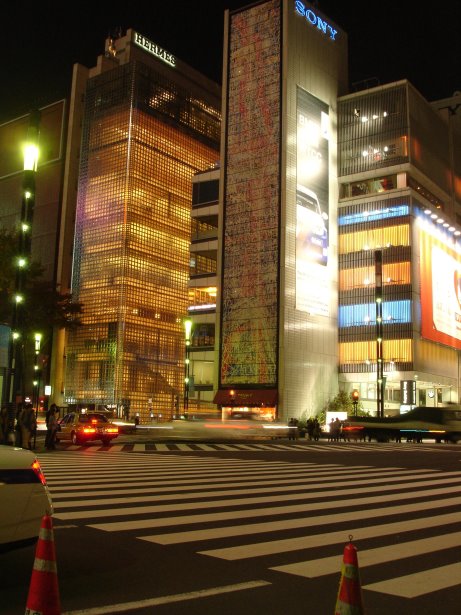
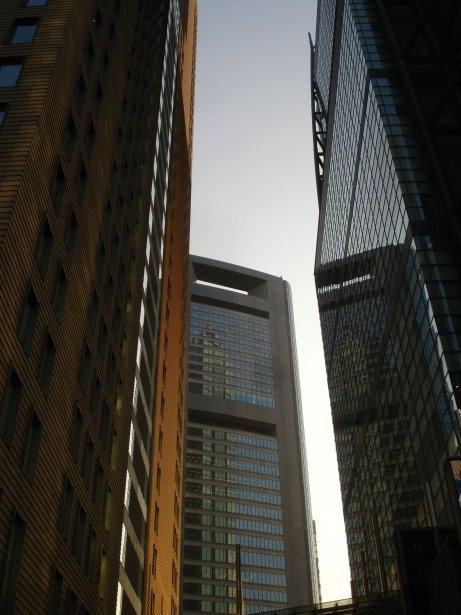
Okay, to the pictures. The first two are of the general Ginza area, the third is the view from a building in Shinbashi (New Bridge), near Ginza, and the last is of a building I thought was interesting near the Rainbow bridge - take a look at the next article if you haven't already. That building says Yokoso at the top on all four sides - Welcome.


Bridges 2

Had a rough day with the neighbor - I may write about it later, but I'd rather share some pictures.

I had a great time wandering the city again, taking pictures of the bridges. I feel much better after a few days of a cold, and it was really nice to enjoy the city again. I wish I had a better camera and some talent, because there are a million pictures to be taken of this city. For now, I hope my 3x zoom digital camera and D in junior high school photography class skills will be enough.

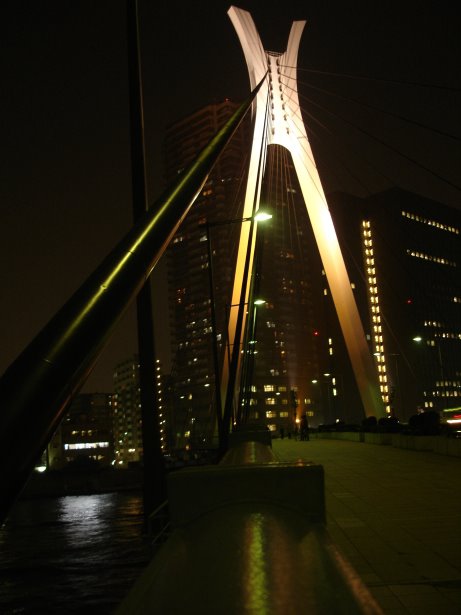
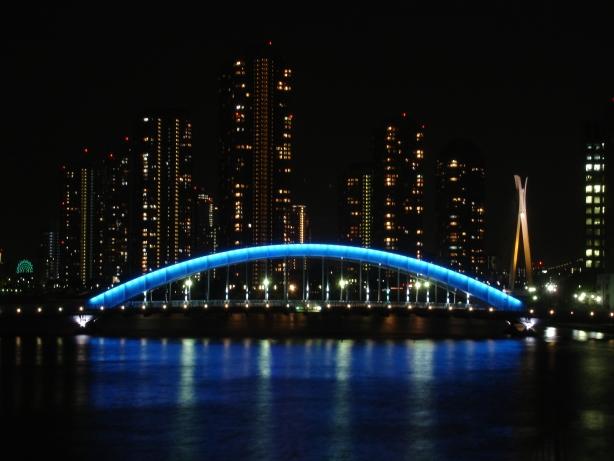
First, we'll start where I left off before. After the arch bridge with the blue lights, there is this, Chuodaibashi (Central Big Bridge).


You can see it in the previous picture of the arched bridge. This is the first bridge after the Sumida River branches off to the west - there is a small island between the two branches, upon which are built the Blade Runner-looking hotels or apartment buildings shown in that previous picture.

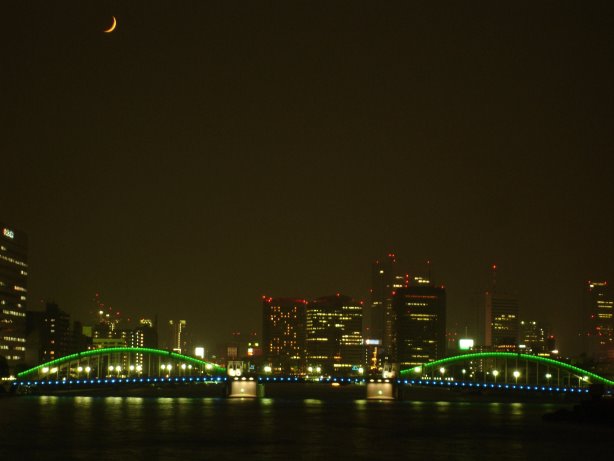
Next is the Kachidoshibashi (Victory Cry Bridge). Well, actually, there is a bridge in between these two from which I took this picture, but it is unremarkable. I took several pictures of Kachidoshibashi, and I decided to include these two because on the one hand I like the first best, but the second shows the whole, two-arch span of the bridge.


Many of these pictures were ruined by the clouds that kept obscuring the moon. At first I thought the moon had set faster than I predicted!

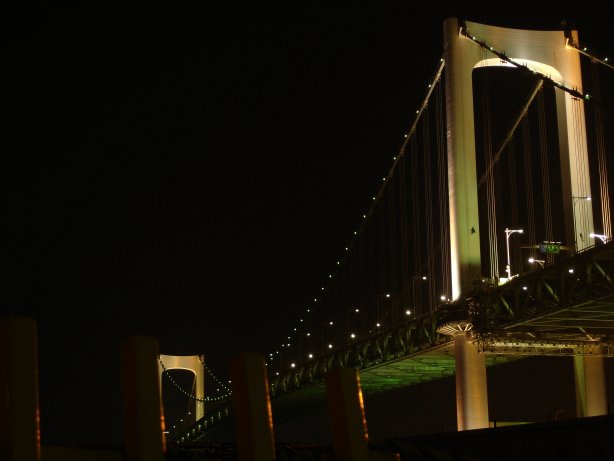
Finally, there is the Rainbow bridge, which connects Tokyo to the strange island of Minato Mirai (The Future in the Bay or the Future Bay). This is a sort of amusement park of the future I have yet to visit.

In any case, I wasn't all that impressed by the Rainbow bridge. I'd heard a lot about it, but I think Eidaibashi or Kachidoshibashi are more interesting. The Rainbow bridge is newer and longer, but big deal. Also, it is illuminated by green lights only, so the Rainbow (they use the English word, not the native Japanese word) is really a misnomer. There are a couple of bridges nearby that do have multicolored pillars, and they deserve the title more. Unfortunately they are not illuminated, so I'll have to take a picture during the day some time. Oh, by the way, the lights on the hanging wires (I forgot what they are called and don't feel like looking it up right now) are green. You can't tell because of the long exposure, I guess.

Thursday, November 03, 2005

Basho basho

Today I went to look at a new apartment in Morishita ("below the forest"), a place by the Basho museum in eastern Tokyo. If asked what period of time and place I'd like to live in, I'd say wandering Japan in the time of Basho (really Bashou 芭蕉 - he took his name from the banana plants that grew outside his hut, also called basho) , the Japanese haiku poet, travelling with Bashou himself. The Japanese word for "place" is basho, thus my little pun in the title. Not very funny, but whatever.

Having a bit of "buyer's remorse," which is absolutely ridiculous. The new place is actually clean, with nice clean beds, the shower's pipes aren't stopped up, the lounge isn't right next to my head (and thus I won't be woken up at 6 in the morning when my roommate comes in and plays crappy 80's music), and I don't have to deal with a slightly off-kilter Swedish neighbor who believes he took on an entire Zen monastery and beat them all (uh, whatever that means) by somehow treating them to mixture of "alcohol, herbs, and glass" that put them to sleep. I first noticed his oddity when he said he was giving himself electric shocks in order to control the roaches in his room. He's not particularly scary and these things only come up once in a while, but of course I don't particularly enjoy it when they do.

But as the Japanese proverb goes, "if you live somewhere, it's the capital" - in other words, you get used to where you are. I have to admit I like the neighborhood I'm in, with all its little alleys and more "residential" feel.

This is one thing that has really stood out so far in my travels - no matter what has been going on, the new seems like the best, until the day comes to make a commitment - whether it is to leave Tokyo for Osaka, or Osaka for Nara, or Nara for Hiroshima, or Hiroshima for Tokyo again. Well, actually, coming back to Tokyo wasn't so bad, although I ended up in this crappy place (hmm). So what I've come up with is - I constantly crave change, and yet I am afraid to commit to change. Or, more simply (maybe), I'm afraid to commit to anything, and the new thing always seems better because I don't have to commit to where I am. Ah, something like that.

This new place is definitely serendipitous. When I first came to Tokyo, in addition to the many sites listed in my guidebook, I really wanted to visit the Basho museum. I did, along with many other Basho sites in the area. The museum was closed, unfortunately, but I saw the outside garden with its small repository for guests to leave haiku (a common practice). I enjoyed Morishita and thought it would be really nice to live in the area one day, visiting the temple and dropping off a poem now and again.

I decided recently to look for a new place to stay, and remembering this I searched for a place in Morishita. I found one. And you know what? The new apartment is not a train stop away, not a few blocks away, but a few feet (or should I say meters) away from the museum with its garden and poem slot. How do you like that?

PS. I decided to look up the meaning of serendipitous, as I have a tendency to associate two words (like serendipity and synchronicity) and mistake them one for the other. I think serendipitous is more correct, but the main thing is I thought the entry was interesting. From dictionary.com's entry:

Word History: We are indebted to the English author Horace Walpole for the word serendipity, which he coined in one of the 3,000 or more letters on which his literary reputation primarily rests. In a letter of January 28, 1754, Walpole says that “this discovery, indeed, is almost of that kind which I call Serendipity, a very expressive word.” Walpole formed the word on an old name for Sri Lanka, Serendip. He explained that this name was part of the title of “a silly fairy tale, called The Three Princes of Serendip: as their highnesses traveled, they were always making discoveries, by accidents and sagacity, of things which they were not in quest of....”

Also serendipitous (though less interesting) is that I wrote a paper on Walpole's Castle of Otranto, the first (European) Gothic novel, last semester. Pretty terrible book, but it had some great themes that were explored throughout world literature and it began a new genre that placed intuition higher than reason in response to the industrial revolution.

Monday, October 31, 2005

One step closer to being truly Japanese

Today I finally gave in and rented a cell phone. I had to go all the way to Narita airport , $10 each way, but this special bonus price I got was still cheaper than anywhere else. On the way home I fit in so well with the other travellers playing games on my phone.

In other news - changed my flight to a month later, the day before my tourist visa expires. Pretty excited - a whole other month to bleed money and not find a job! Seriously, though, I got my first job offer today, I could go in and interview for an Executive Search Consultant (headhunter) job tomorrow if I... well, if I were a different person. I didn't apply for the job - they saw my resume on a job bank. Still, it was nice to see something in my job mailbox. And now I can finally put a Tokyo phone number on my resume. Hopefully that will cinch the deal.

Got sick today, too - yippee! It's beginning to get cold here and I think my body is noticing the change. It's been five years since I've been through an actual change of season!

Sunday, October 30, 2005

Autumn celebrations east and west

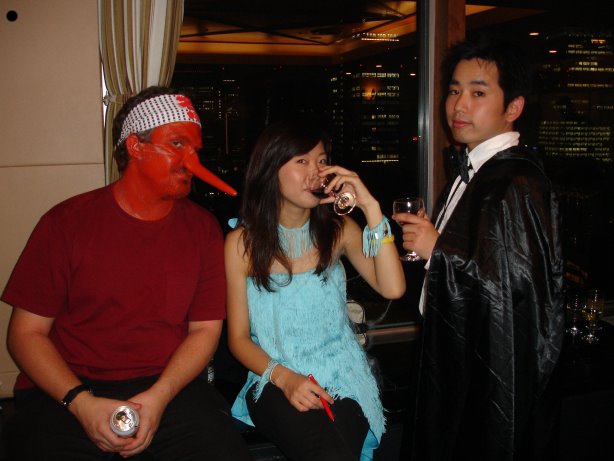
Yesterday friends and I went to a Halloween party at the Foreign Correspondents' Club. It was quite a party - I dressed as a Tengu with a long nose and wings and was unusually popular. Not much chance to "network" with expats, as I spent almost every moment being photographed with a Japanese person. Had fun in any case.
Our costumes, mine the silliest. Sachi is the one drinking, and Etsuro is on the far right

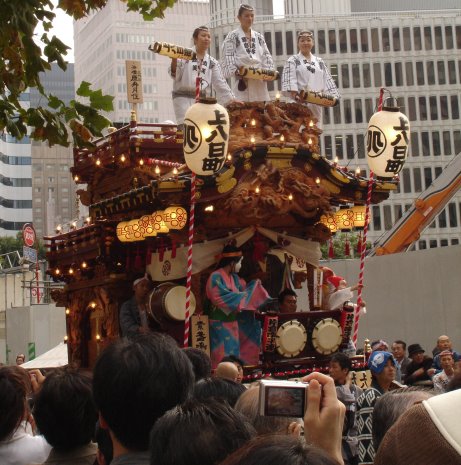
Today I went to the Edo festival in the center of the city. There were several floats like this one, along with dancers and jugglers.
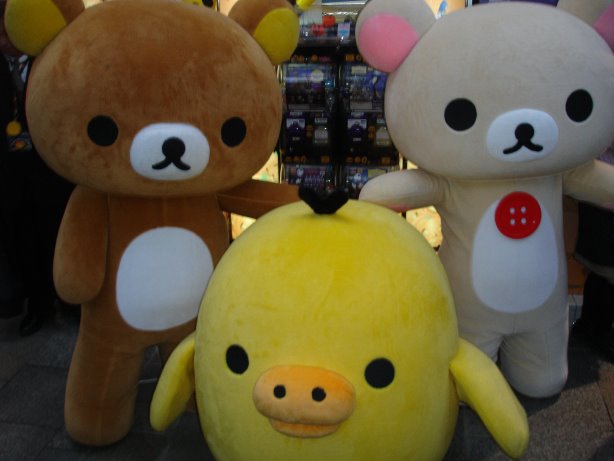
Finally, on the way to Meiji shrine (this has become a weekly pilgimage for me), I ran into these bears and, uh duck?

Friday, October 28, 2005

Chanpon (or Potporri)

Today, a mix of things.

First, I think I'm going to stay in Japan for another month at least. I have a return ticket for Nov. 14th, I think it is, but my visa is good until Dec. 12th. So I'm going to try to change my ticket. It'll probably cost some money to change the ticket, but it'd be a waste to go back without really giving this thing the best try I can.

At the same time, I've found a place in a part of Tokyo I really like for not much more than I'm paying now. Today or Monday I'm going to go take a look at it, and then I'll move in the middle of next month. I'm very excited, and I hope it is better than the place I'm in now. It's in the same part of town as the Basho museum and a beautiful park.

Next - I thought maybe you'd like to know where I am an what I'm doing. The other day I wrote up a thing on the subways and in the process decided to put up a map of the subways. Unfortunately I shut down my computer before I posted the article on subways, but I'll go ahead and put up a subway map with key locations, so you can at least get a feel for what I've been doing.


If you click on the photo it'll bring up a large version (like all the pictures I post on here).

Quick note here - usually Japanese maps don't point north; instead, they show where you are facing. Little quirk I have been meaning to mention - it is both very confusing and, once you get used to it, more intuitive than having every map point north. This map, though, does point north, though of course it isn't an accurate representation of Tokyo.

First of all, notice the skinny, banded railway line that encircles the city - it is sort of hard to see because it is black and white, but it is there. This is the Yamanote ("In front of the mountain") line. This is sort of the unofficial boundary of "Tokyo proper," where all the cool stuff is.

To the north I've circled in dark green the place I am now. You'll notice that I'm outside of the banded line, and thus I'm outside of Tokyo proper. That's okay, because it is kind of nice to come home to a quiet area (it's still pretty urban, though, sort of like Brooklyn, say). On the other hand, it is a pain in the ass because it takes forever to get to where I want to go. For example, to get to the Meiji shrine, my favorite place in Tokyo, circled in black in the southwestern corner, it takes about 40 minutes and 210 yen (~$1.90) each way. Shibuya, also a neat place and the location of the huge intersection scene with thousands of people crossing in Lost in Translation, is a longer trip and is 290 yen each way. But that's nothing, of course: many people spend 2-3 hours commuting each way, and who knows how much that costs ! (companies often pay for transportation, though)

A more central location, but more expensive, was the first place I stayed in Tokyo, the "Guess T House," in Azabu Juban (Hemp Tenth??), the place circled in light green to the south. I once walked from Shibuya to that hostel and it only took about an hour and a half. It would probably take about 6 hours or more to walk from here to Shibuya.

There's a nice used books section, not quite as nice as Paris's but still good, in Jinbocho, marked on the map in blue, near the center. Cheap books, with tons of books on mythology and religion! Yay!

Finally, to the east is Morishita, the place I might move to next month. It's also sort of "in the boonies", and it is only served by two railway lines (the place I'm at now is served by four), but it is beautiful and historical. I fell in love with the area the first time I was in Tokyo.

Okay, that's today's lesson in Tokyo geography. I want to try to label a satellite image at some point, but not today.

Because today I need to find a costume! Yes, that's right, Halloween in Tokyo. I guess it is a pretty small affair here, nothing like San Francisco, but it ought to be fun in any case. I'm going with friends to a party at the Foreign Correspondents' Club, which may also be a chance to "network" with expatriots. Later, I've heard, the gaijin make a ruckus on the previously mentioned Yamanote line in their outfits. Sounds like fun. Also sounds a little dangerous and expensive (Yamanote is fast but expensive). But I'll have to give it a try for the experience.

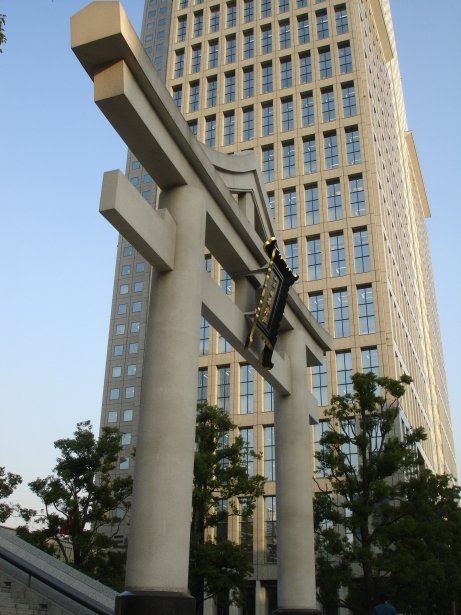
Finally, I'll finish my Chanpon soup (chanpon means mixing everything up in a stew-like thing) with a visit yesterday to an important shrine in Akasaka. It has something to do with a mountain god, though I'm too lazy to research more than that at the moment. But it is closely connected to the Emperor and fairly well-maintained.

First, the entryway torii. I thought this picture would work well in an elementary school World Geography textbook with the caption: "Japan is a country of contrasts." (That's humor, by the way)


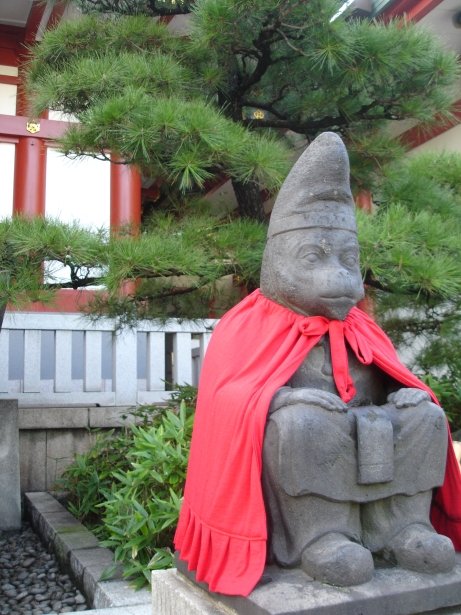
Umm, a monkey priest. Don't know the story.


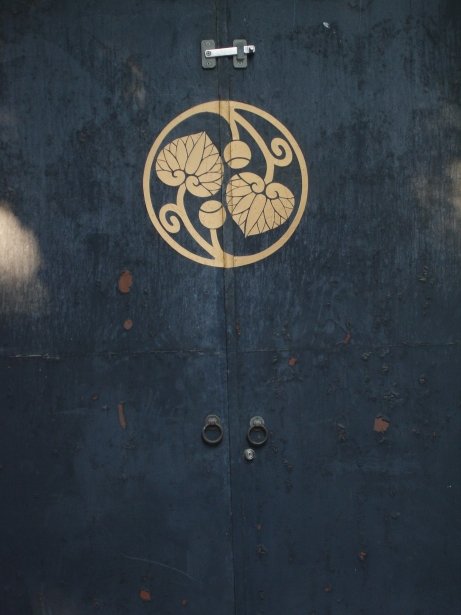
Thought the emblem that adorns the shrine in many places was very pretty. So I took a picture of it.

Thursday, October 27, 2005

Tokyo at Night 2- Bridges of Tokyo County

Blogger only allows you to put 5 photos in one article, so I decided to split my night photos into two sections, the second (ie this one) focussing on bridges in Tokyo.

Last night, sort of arbitrarily I decided to take a tour of Nihonbashi and the Sumida River's bridges. There are some very interesting bridges along the Sumida, and though unfortunately I didn't do a very good job of capturing them, you'll get the general idea. These are only a few of the bridges: I'll have to get the others later (they are farther away, and thus it takes more money to ride the train there).

First is Nihonbashi. When the Shogun moved his powerbase to Tokyo (then called Edo), all of the roads were measured from Nihonbashi, and this continues today. The Nihonbashi, unlike the other bridges in this collection, isn't over the Sumida river, but over a river nearer the imperial palace (during the Edo period the site of the Shogun's fortifications) called... Nihonbashi river. By the way, Nihonbashi means Japan bridge. I'm guessing that the river was called something else previously, but I don't know what it was. It's not such a great river, and like many of the rivers in Japan, there is an expressway directly above it, so is somewhat depressing. But history, history is the important thing here. And this bridge is very historical, with very interesting dragons that are a nice mix of Asian and Western dragons.


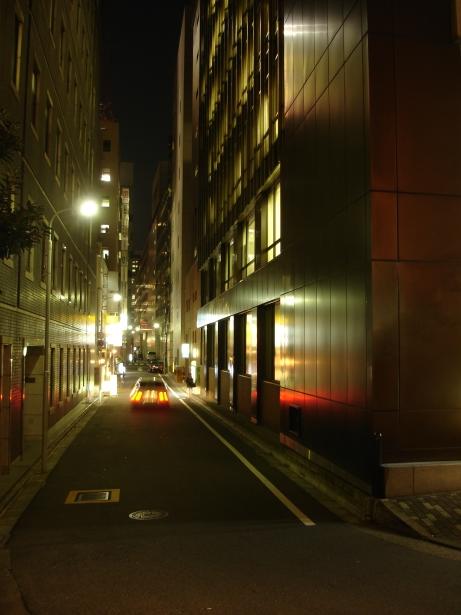
I realized recently why the streets in Tokyo are so small: they have no sidewalks. There are, of course, large thoroughfares with wide sidewalks, but, like this Nihonbashi alley, most do not.


Next I wandered towards the Sumida. The Sumida was once a particularly beautiful river, and I tried to imagine its former glory as walked along the promenade. Unfortunately now it is completely encased in concrete and is as much a man-made thing these days as is the Tokyo Metropolitan government building (a vaguely threatening, Gotham-looking building I have yet to visit). In spite of that, however, it is still a body of water and, as such, still very interesting. The promenade, too, does its best to forget that it is all just concrete, and it succeeds as best it can. It is pretty in its own way. I imagined to myself how beautiful it must be to watch the competing fireworks that take place over the Sumida every year, trying to forget that at one point the power and threat of a river was just as beautiful as safety and economic prosperity.

Anyway, it truly is beautiful there, especially looking at the bridges as you walk along the tamed river.


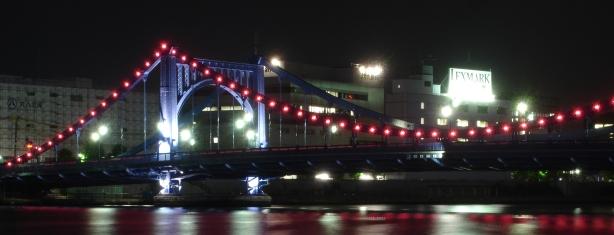
First ( that I saw, there are actually many more to the north of this bridge) is the Kiyohashi, fairly boring looking other than its lights illuminating it in purple.

Finally for this trip is the Eitai bridge, a cute little thing with a particularly impressive light display. The lights change over the course of the year, though I'm not sure what the pattern is. This bridge and the buildings behind it capture, I think, the influence of Tokyo on Blade Runner.

Tokyo at Night

I've been doing a lot of walking at night. I spend most of the day looking for jobs, telling myself I'll go out and see the city as soon as I get that... last... email sent. By the time I end up doing that, however, it's already 5, which means I'll be going out at night.

So I walk around after dark, taking photos and thinking. I've found taking photos is particularly relaxing because while I'm sightseeing and discovering new parts of the city, taking pictures for myself and others, I get absorbed in that and forget that I can't find a job and that in less than three weeks I might actually get on a plane and leave this place.

Here are some of the fruits of my nighttime travels. Unfortunately I'm not very good, so many of the photos are slightly out of focus, though at the size you'll see you can't tell very well.


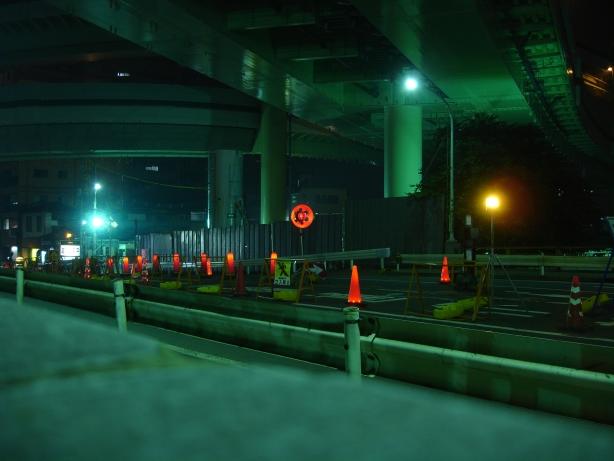
This first is of night construction going on near the place I'm staying. Not all that interesting, I suppose, but I like the glow in the dark traffic cones. That red circular thing, though you can't tell, is actually a rotating light to catch your eye.


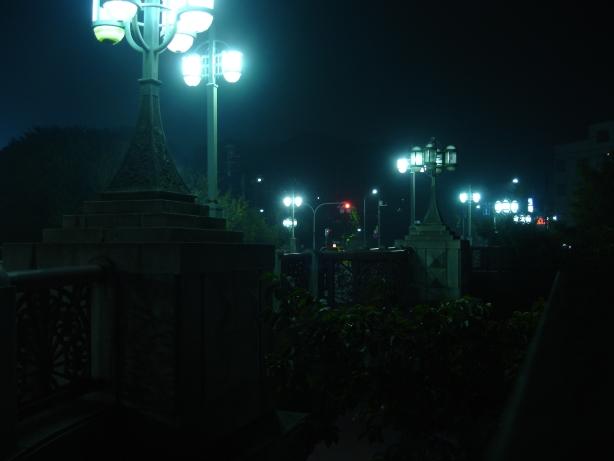
Next, these are some lamps at a bridge near my apartment, a bridge called "no sound bridge." I've walked under it, though, and it makes echoes just like every other bridge I've seen/heard.


Last in this collection is Kaminarimon at night. Not only is this a very famous site in Japan, it's a gate dedicated to Thunder! How can you beat that! Unlike the other two, this is quite a ways from where I'm staying, in an older part of town called Asakusa (wet grass).

Monday, October 24, 2005

Frustration

Beginning to feel the pressure a little bit. Naively, I thought I could easily get a job here based on the fact that I know some Japanese, but I'm beginning to realize that has very little to do with it. More important, perhaps, is what skills I have, and unfortunately, the only proven skills I have are related to computers, work I absolutely will not do. I do believe I have something to offer, I'm just not sure what yet.

I have heard many times that networking is important, and I know from experience it is true. I think maybe 95% of the jobs I've gotten have been through friends. But how to build a network in a country where I can barely speak and that is notorious for avoiding strangers? If the stupid American government would reciprocate a working holiday agreement (where you can work for six months or more - Canada, Australia, and many other countries do it), I could do part-time crap jobs while I built a network. But no. Honestly, I'm very angry at arrogant and unilateral policies in the US, especially when they keep me from getting a job... As it is, I either have to accept a job in Japan sight unseen - the most you see before you find out whether you got the job is a few days while interviewing, during which time the employer can put on a pretty face - or come to the country, as I have done, on a tourist non-visa under the terms of which it is basically illegal to even look for a job. I'm not here to work for less than a Japanese national, and I'm not here to work in the sex industry - I really just want to work, and have higher aspirations to bring together the cultures of Japan and the US than your average fresh-out-of-school American youngster.

I shouldn't whine like this, it is unbecoming, but I feel helpless. I suppose I'd have a hard time finding a job in the US, too, but at least I could work at Starbucks or something while I look for something better. Like every other humanities graduate...

Saturday, October 22, 2005

A Few Observations and A Couple of Translation Notes

I'm still doing some "summarizing" of the things that I have seen, heard, learned, etc., over the last month, and there are a few more things I find humorous and a couple of extra-linguistic culture notes that helped me to better understand the translation of the books I've read in Japanese.

Again, the observations are in no particular order.

Sunglasses are extremely rare here, and when you see darkened glasses, they are never very dark : usually nothing more than a light yellow or very light brown. I asked a friend why this was true, and he said that Japanese don't generally like darkness. I doubt that is the true answer - I mean, what culture does like darkness? - but I let it slide.

When cars stop at a light, they'll often turn off their lights. I haven't asked why they do this, but it is very common. I think it is either to save a miniscule amount of gas, or else to avoid bothering the person across the intersection, much as Americans will turn down their brights when another car comes from the other direction.

Japanese people place great value on community and discussion. I heard this before I came, but I didn't really realize how prevalent it was. One place this is particularly noticeable is on television. Nearly every program, it seems, has a panel of celebrities commenting on it. There are, of course, the Hollywood Squares-style programs that you often see from Japanese television broadcast in San Francisco, but it goes further than this. Documentaries, like those shown on Discovery channel, are commented on by a panel of celebrities (celebrities, mind you, not experts in the slightest, just entertainers). Another show chooses a celebrity, showcases their diet, then, while the group of celebrities around the celebrity in the bad diet spotlight make comments, a panel of actual experts (I don't know their qualifications, but they aren't funny and they wear white frocks, so I assume they are experts) - and notice it is a group of experts, not just one - make predictions about how the diet will affect their health in the future. These are examples, but it really is astonishing when you watch much Japanese television to see how important group discussion is to television culture.

Okay, that's it for the "quirkiness" observations.

I also was pretty happy to come across a couple of things on my trip that have helped me understand books I've been reading Japanese better - because, heck, if it weren't for the fact I want to be a translator of Japanese, I might not be here.

Beyond a general feel for the culture and a chance to put images to the names of Japanese places that come up in Japanese literature, there are a couple of specific things I was happy to come across that made a big difference in my understanding of, in this case, Haruki Murakami's The Wind-up Bird Chronicle and Kafka by the Sea.

First is from Kafka by the Sea, and while it is simple and really not a big deal, if I had not come here I would have had to spend a great deal of research on it: the word ローソン. If you can't read Japanese or that is just a bunch of gobbledy-gook, the word was Rohson. I came across it as I was reading the other day and, as I often have to with words transliterated into Japanese, I had to sound it out to myself, but finally after a few seconds it was obvious, from the context and from the experience I've had here, what the word meant. If anyone can is studying Japanese, can you guess what the word is?

The word is Lawson, and it is the name of a famous convenience store here in Japan. There are four main "conbinis" that I have seen: 7-11 (yes, that's right, and the 7-11 company even has a bank now), ampm, Family Somethingorother (can't remember the full name), and Lawson. There are others, but those are the most common. Convenience stores are where you go to buy fairly good prepared food, beer, cables for your electronic devices, where you pick up packages, and a great many other things. They are not (usually - there are exceptions) the dirty and often unsafe places that they can be in San Francisco.

Anyway, I know it is a small deal, but the fact that this so quickly came to me was a real validation of the belief that coming here is essential to continue learning the language.

The second occurred to me when wandering home today after getting lost for the billionth time. The streets, other than the main streets that cut across the entire metropolis, are usually very short and small and follow no particular pattern in Tokyo. Instead of groups of parallel streets, the streets here often cut across each other, end after a few meters, and/or are about an arms' length across.

Houses are found not by walking down a street until you find the right number, but by a slow narrowing of areas until you have narrowed the possibilites down to a very small number. In the US we would first find the city, then the street. It helps to have some idea of the area the house is in, but if you use the brute force method, you can usually start at 1 and walk to the address if you know the street, and if you see the address of houses in a particular area of that street you can guess how far you are from your destination. This is not the case in Tokyo. For example, the place I am staying now is in a numbered area 15 of a subsection called Sakae town of the Kita ward of Tokyo. This means first you have to find Tokyo, then the Kita ward. Once you have found Kita, you have to figure out where Sakae town is. The only way to do this is to have a map with a good index or ask a local. I had both Japanese google's maps and a paper map, so I didn't bother to ask a local. But even when you have found the town, you still have to find the section, called a Chome, then find the numbered part of that chome that corresponds to your address. It took me about two hours, I think, to find this place the first time, and now I've managed to lower that to, on average, about 15-20 minutes, depending on where I am coming from. But it can be a crap shoot.

There is a point (sort of) to all of this, if you've managed to make it this far.

There is a part of Murakami's The Wind-up Bird Chronicle where he describes an alley the main character enters while trying to find his lost cat. When I read this both in English translation and in Japanese, I was imagining to myself the wide alleys we have in the US - even the narrow alleys can usually acommodate a Hummer. Not in Japan. As I said before, many of the alleys are only a meters wide, if that, and only very small cars (there are many small cars here) can get through.

In Murakami's story, this alley has been blocked off by construction over the years. In the US, while plausible, this would be a real oddity, and thinking of the alley the way I had been thinking makes the whole scenario much more surreal than it really is. In fact, you run into deadends all the time here, without any explanation, and as walls go up to protect the miniscule gardens of the tenants within, it is very likely that one of these tiny alleys might get blocked off.

It is an important point, because the alley helps to create the atmosphere of isolation that is a trademark of Murakami's style and, I think, one of the reasons he is so popular. The main character, stranded in the alley - almost a sacred space because it is cut off from the normal thoroughfares of human life - pauses for a moment to consider what connection there is between the lost cat and his ailing marriage, beginning a subtle undertone of jealousy and misplaced trust that come to a climax only hundreds of pages later. The alley, once useful to connect houses, people, places together, now only serves as a barrier between them. It is a potent symbol that only grows in relevance the more I focus on it.

Knowing that this closing off of an alley is very plausible in Tokyo takes away some the of the absurdity that I originally read into the alley, but it doesn't take away strength of the symbol itself.

I'm sure no one is reading anymore, and I'm tired, so I'll end it here.
Wednesday, October 12, 2005

A month in Japan!

Well, as of today, I've been here a full month!

It's been a long month, a lot of fun, with occasional worries and a few missed opportunities, but overall a very good experience. I thought I'd celebrate the last month by writing down some interesting things I've noticed about Japan in the past month.

In no particular order:

Vending machines
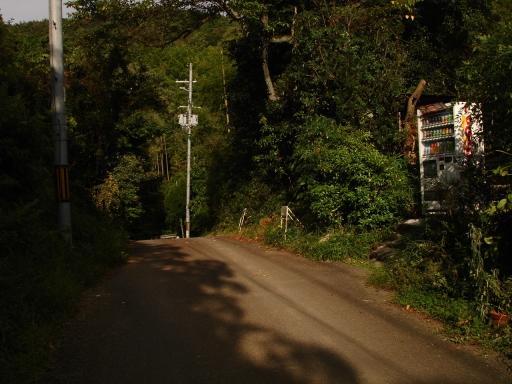
There are vending machines everywhere. EVERYWHERE. I walked up the mountain at Fushimi inari shrine - the one with the billion torii I mentioned in an earlier entry - got a bit off track and ended up in the "middle of nowhere" (the middle of nowhere doesn't really seem to exist here, but for the sake of simplicity...) and there was a bright, shiny vending machine, carrying my favorite canned coffee, Georgia brand espresso latte.
I was so impressed, I took a picture.


Kuru kuru sushi and hamburgers


This is kuru kuru sushi. If you've seen those sushi boat restaurants in San Francisco, it's sort of like that, except that it's nothing like it. A wide variety of sushi floats by your table on a conveyer belt, you take what you want, and then at the end you put your empty plates into a machine at your table that counts the dishes and gives your your receipt. The sushi is usually 100 Yen a plate, which makes out to be about 85 cents or so. The sushi goes around the entire restaurant, though, and I believe it comes back around again, so the sushi tends to get gross and kind of sweaty after awhile (at least at the place I went in Nara - I've heard there's a better place here in Hiroshima). But it's an experience.


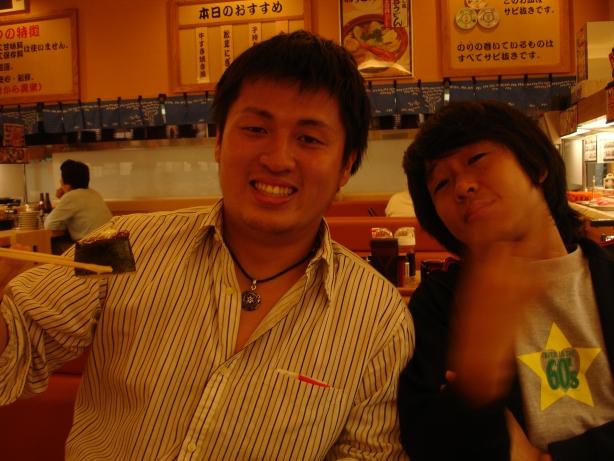
If you can't tell, that is hamburger sushi. Yes, a slimy clump of hamburger (cooked, you'll be happy to hear), on top of your usual sushi rice wrapped in nori seaweed. It even has a little mayonnaise on top! The guy in the picture above is a big fan of American culture, drinks Coca-cola all day, and loves hamburger sushi.

The Condition of the Service Industry in Japan

This has been the hardest thing to adjust to so far, I think: customer service is on a whole different level in Japan, especially Tokyo. Whenever you go into a store, everyone in the store (everyone, this can be 10-20 people) will say "Welcome" (Irasshaimase) This happens everytime someone comes in, so you will hear an almost constant stream of "Irasshaimase"s while you are shopping. In addition, most stores will also thank customers who are leaving, so when someone pays or leaves (very often both), you will hear "arigato gozaimasu" or the slightly lazier "arizasu".

Even more, the servers will often inform other servers or the cooks of customer's orders. Before I go on, I should note that almost all women and many men use a higher than normal, very nasally voice (a habit I am very curious about) when they are doing this. So, when a customer orders something, you will a long, very ritualized conversation about the order. I don't have a full understanding of everything that is said, but in coffee shops (Starbucks and Tully's are popular here) here is the gist of a typical order-conversation. Remember, most of the time this is in a high pitched, nasally voice.

I come in
The first person notices a customer has come in, says "Irasshaimase". Everyone else then follows, in a sort of echo.
I fumble out my order: "short cappucino"
The person taking my order says to everyone (in Japanese): "I'm going to make a request".
A customer leaves: "Arigato gozaimasu, arigato gozaimasu, arigazasu..." then, going back to the order...
Everyone else says "Go ahead"
The person taking the order says "One short cappucino, please".
The person making the drinks says "One short cappucino" in answer.

This is all done very matter of factly, though it is in the ritualized manner I've described. They go about their business (and they are always busy doing something), firing off responses without looking away from their work. It is very hard to get used to, but I admire it.

However, this leads to a much greater amount of noise pollution than most americans are used to. Much worse than this last situation, though, are the supermarkets I've been to. Here, there is not only a soundtrack (usually a store radio), there is also a pre-recorded message thanking you for visiting the store and telling you to "Please take your time and enjoy shopping at...", and even more, there was one store where there were two guys talking on microphones in different parts of the store recommending various items: "How would some celery be for that nabe you are making tonight... Eggs are 2 cents off today... How about some beer...", all of this very loudly. I had a terrible hangover the day I went to this store, and was about to lose my mind in all the noise. Certainly there are noisy department stores in the US, but they cannot compare.

Then you step outside and there are two young women handing out napkins with pictures of either cute little cats or half-naked young women, adding to the noise by asking you to come to the dry cleaners or hostess bar they are promoting. The next corner is the same thing.

Bookstore segregation

Female authors are separated from male authors in the bookstores I have visited. I won't try to explain this one - I'm sure you can come up with your own ideas.

Well, I've spent too much time on this, I want to get back to looking for jobs, but I'll probably
add other things as I think of them.

Monday, October 10, 2005

Pottery and Barbeque

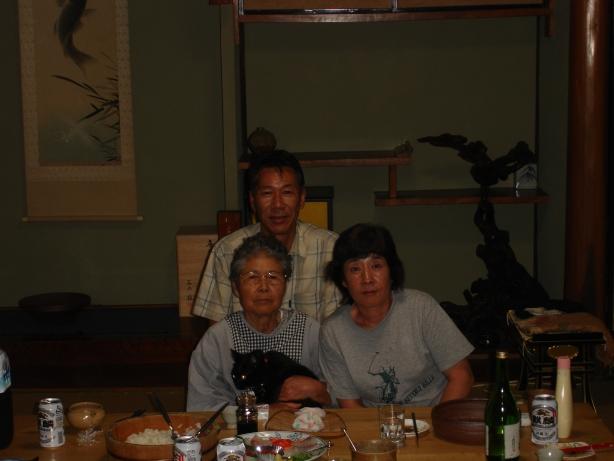
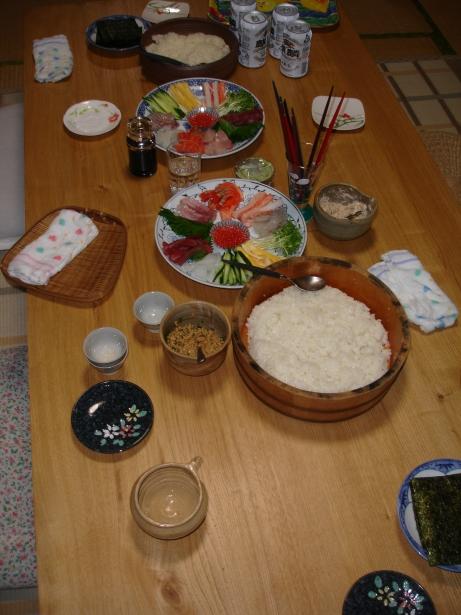
First, a belated picture of the family I'm staying with here in Hiroshima. My friend Shinsuke was still working when we did this, so he's not in the picture, but in back is the Father, in front grandmother and mother, and cat (Kuu).


This was taking just before we had dinner that night, a "make your own" style of sushi.


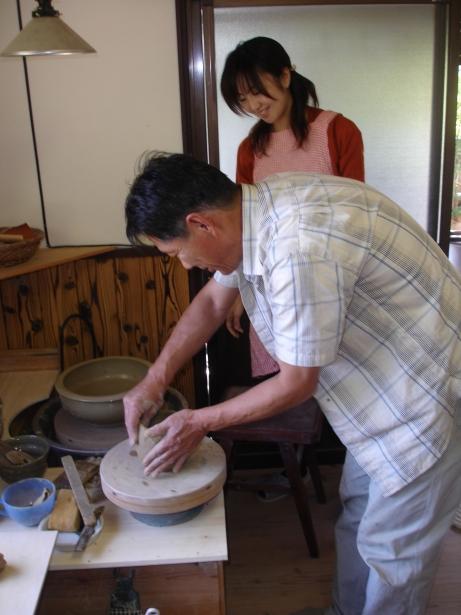
The father is heir to a line of pottery makers, and though he has a full time job as a public servant of some sort and thus can't make any money on the side, he does pottery as a hobby. Yesterday, a friend of Shinsuke's came over to make pottery, and so I was invited along.

The finished product is probably three-quarters the father's doing, but it was interesting to participate.
Then, after that was done, we had a big barbeque, with many of Shinsuke's friends coming to visit and eat with us.

It lasted (or, really, I lasted - the party continued after I went to sleep) from 12 to 12. It was fun, though I ate and drank too much.

Friday, October 07, 2005

Update

Well, I've been in Hiroshima for almost a week now and I've pretty much stopped all of my sightseeing activities while I try to find a job. It seems my options are pretty limited here, and I may, in the end, need to head back to Tokyo. It's hard for me to really understand, but it seems like the head office of every company in Japan is located in Tokyo, and that is really the place to be for any sort of good chance at a job.

I have to admit the reason I'm not working harder to find work in Hiroshima (because I'm sure there must be some sort of work as a proofreader here) is that, despite all of my predictions to the contray, Tokyo really grew on me. Osaka, Hiroshima, even Kyoto, or for that matter San Francisco or New York, are just cities. But Tokyo is a whole other matter altogether - it is a huge sprawling mess filled with way too many people, and yet it somehow seems to work. The fact that it works, along with its array of options for intellectual and other stimulation, really is attractive to me. I haven't made any decisions yet, and I think it probably would be better to stay here in Hiroshima, but because of many factors, I might end up back there.

As usual, I'm trying to figure out a good reason to choose one plan over another. I was, optimistically, hoping that once I got to Hiroshima I would feel "at home". It is definitely nice to see Shinsuke, I really liked Miyajima, the place with the big Torii, and Hiroshima is nestled in between the sea and mountains, but the city itself isn't very attractive.

Ah, anyway, I'm just writing this down because I haven't used English much lately and it is nice to be able to express myself. It feels like most of the time I'm staring blankly at people, trying to figure out what the hell it is they just said at a million miles an hour. I still get the thrill of learning new words in Japanese, but I don't get much of a chance to communicate intelligently for any length of time these days.

Don't take that to mean I'm unhappy. I'm enjoying myself, but I'm looking forward to the next, real adventure in Japan - working. I know that sounds absurd, but after so many years of not being self-reliant, the only thing I want now is to have a job and pay for everything myself. Well, more than that, start to develop a skill at something, ie translation. Hopefully I'll find something worthwhile to do soon.

But tonight, I'm going out drinking with a friend who lived in San Francisco I haven't had a chance to see yet.

Monday, October 03, 2005

omatase shimashita

It's been a while since I've written anything. The title means "I made you wait," or, more naturally in English, "Thank you for waiting." It's said over and over again here - even if you haven't been waiting, people serving you will say it.

I haven't experienced all that much culture shock here in Japan, but this is one area where Japan and the US are so very different: people are unbelievably polite, sometimes so much that it makes me uncomfortable. I myself try to be polite as much as possible, but I often am selfish and impolite, and even when I am being polite, it can't even come close to the great lengths taken by the people that I have stayed with since I got here.
My friend Kazumi and her family in Kishiwada/Osaka, another friend in Nara, Tomo, and the family I am staying with at the moment here in Hiroshima, the Fujiwaras, have gone to great lengths to make me comfortable, taking care of almost everything for me.

I appreciate this so much, but I am not accustomed to it and not sure how to respond in return. I feel unworthy of it, especially since I am not much of a host myself. It seems so natural to them - perhaps living here for a while, it'll become natural for me as well.

So, I've finally reached Hiroshima, and after a few days of sightseeing I plan to start looking for a job. I'm glad, in the end, that I chose Hiroshima - it is a beautiful place, surrounded by mountains, with much of the big-city conveniences of larger cities but without the overwhelming size of cities like Osaka or Tokyo. I don't know if I'll end up here, but if I do I think it will be fairly easy to settle in.

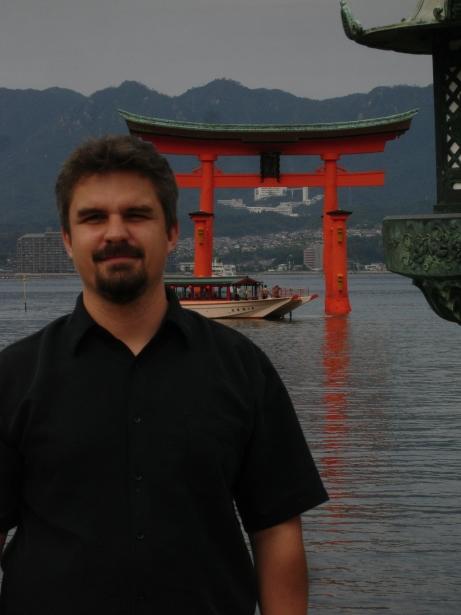
Today, Fujiwara (his given name is Shinsuke, but I usually call him just Fuji-san) and I went to Miyajima, with the famous Torii. It is an island fairly far away from the main city and is very beautiful.

Tuesday, September 27, 2005

Osaka and beyond

Well, I'm leaving Osaka without really having been there. Unfortunately, since I left Tokyo I have been rushing around, and only spent two days in Kyoto. I've been in a suburb of Osaka since then, and spent only a couple of hours in the city itself.

It was interesting being in the suburbs. I've been staying with a friend and her mother in Kishiwada, a city nearer the airport than Osaka itself. To be honest, Kishiwada reminds me more of the Midwest than anywhere in Japan: while there are certainly reminders that I am in Japan, like the genkan where you take your shoes off and then enter the house proper by taking a step up, on the whole the city is very similar to towns in the Midwest. There are long strips of roads lined with malls, and the house I stayed in has a very western feel to it. It reminds me a lot of an aunt's or grandmother's house, with cutesy little knickknacks and candy everywhere. She is a grandmother, so I suppose it fits, but it was just so reminiscent of my childhood.
My friend Kazumi's mother, sister, and niece

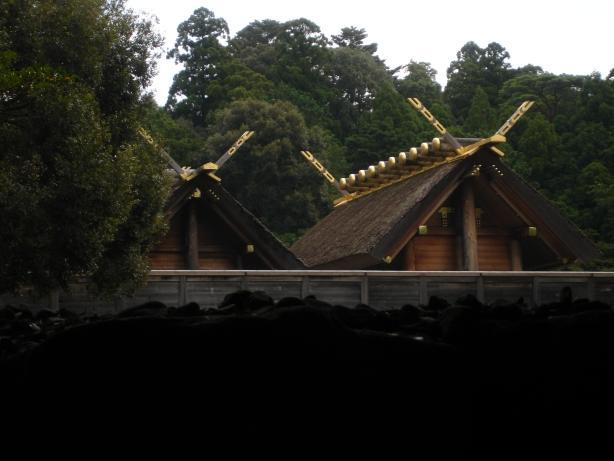
Because my rail pass will expire on Thursday, I decided to leave Osaka - as I said, without really having spent much time here - to go to Ise, the center of the Shinto religion. Here a building that is rebuilt from scratch every twenty years holds the mirror of Amaterasu, the central goddess of Shinto and the direct ancestor of the Emperor.


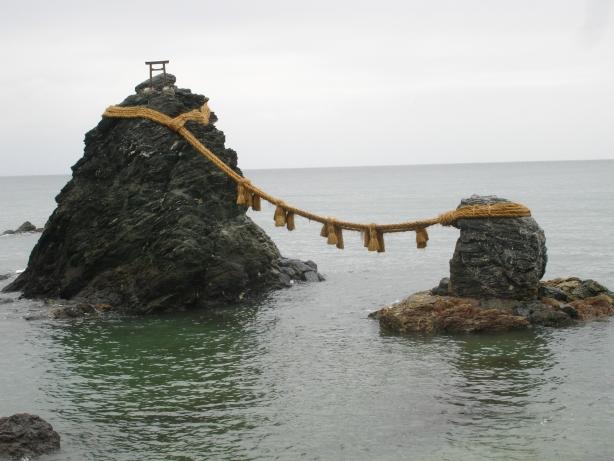
There is also a famous shrine with two rocks, thought of as husband and wife, very near where I stayed when I went to Ise

Saturday, September 24, 2005

Torii Torii Torii

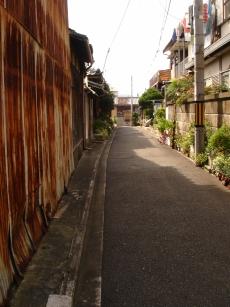
Today's the first full day in Kyoto. To be honest, my first impressions of the city weren't all that enjoyable - I had a terrible time finding the hostel I'm staying in because of the tiny alleys


(no that is a street, not an alley), and with a heavy pack and bags it isn't much fun. I finally was able to find the place, however, and I ended up having an enjoyable day today.

I started with the Sanjuugendo, a temple with a ton of Kannons. Taking pictures isn't allowed, so I don't have any, but it is an amazing spectacle. There are hundreds of statues and each is subtly different from the next. You can only really see the front row, though, and after the 30th column or so they start to blend together. It was worth seeing for the sheer wow factor, but I left feeling a bit empty, as I often do when I leave buddhist temples (I guess you are supposed to feel empty after a visit to a Buddhist temple?)

What made the day was a visit to the Fushimi Inari temple to the south. This is a shinto shrine celebrating Inari, a god of rice, I believe, who is accompanied by two ghostly foxes.

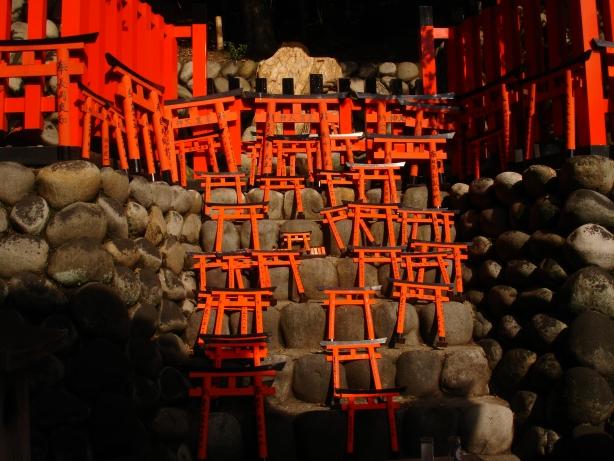
I'm a big fan of toriis, the gates that adorn shinto shrines (there is a picture of a torii from the Meiji shrine in Tokyo in this blog), and this place is crazy for torii I was in heaven when I saw this, but this was just the beginning. There are Torii everywhere, from the small torii above to huge gate-like torii that you walk through in much of the shrine.


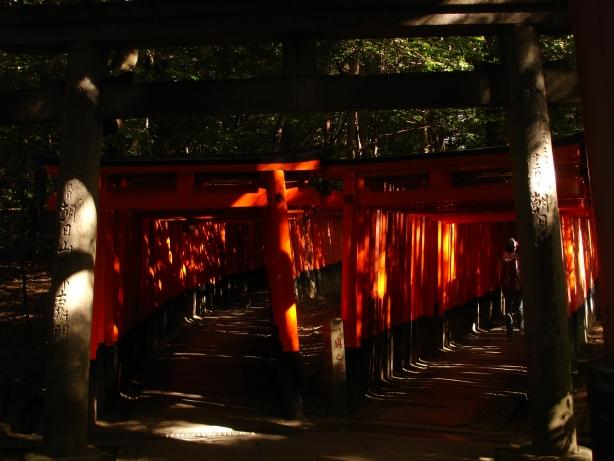
This image just scratches the surface - the torii are stacked like this for miles, and though I spent about 2-3 hours wandering through the park (actually a mountain - I went to the top as well), I didn't see all of them. You walk through the torii to the next shrine which is covered with torii


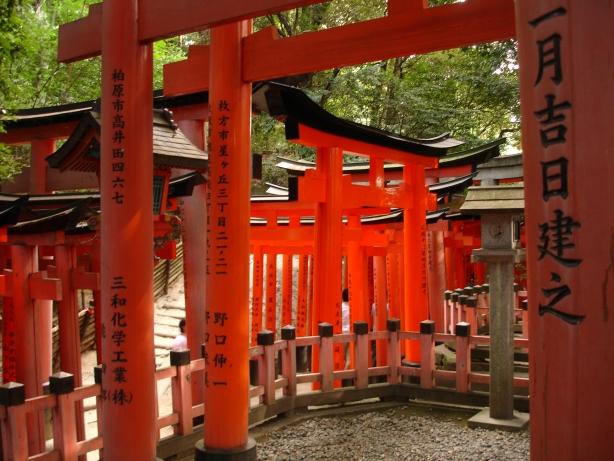
then you walk through another group of torii.

I took hundreds of pictures of the things, but could hardly have captured a thousandth of the number that are there.

Well, I've rested up and now I'm going to try to catch a bit of Gion (the "entertainment district") after dark. I guess I'm going to head to Osaka tomorrow, though Kyoto is so close I will probably come back.

Monday, September 19, 2005

Japan, Japan, Japan


Well, I'm still in Tokyo, despite what I told everyone. I couldn't get a reservation for the places I wanted to go, so I have just stayed here, and I'll probably just head to Osaka and Kyoto, saving myself some money.
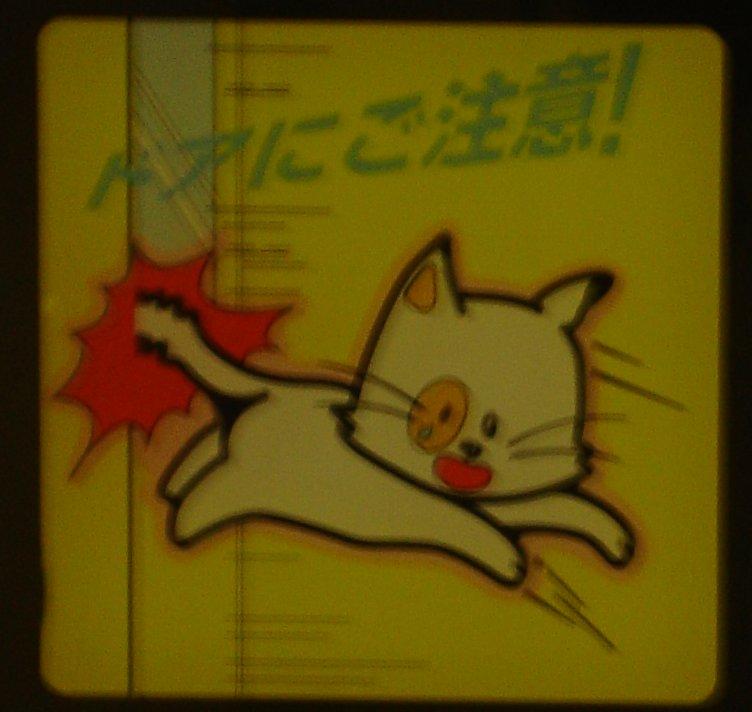
Anyway, thought I'd share the cute little cat that rides the Tokyo Metro, reminding passengers not to get their tails caught in the doors.